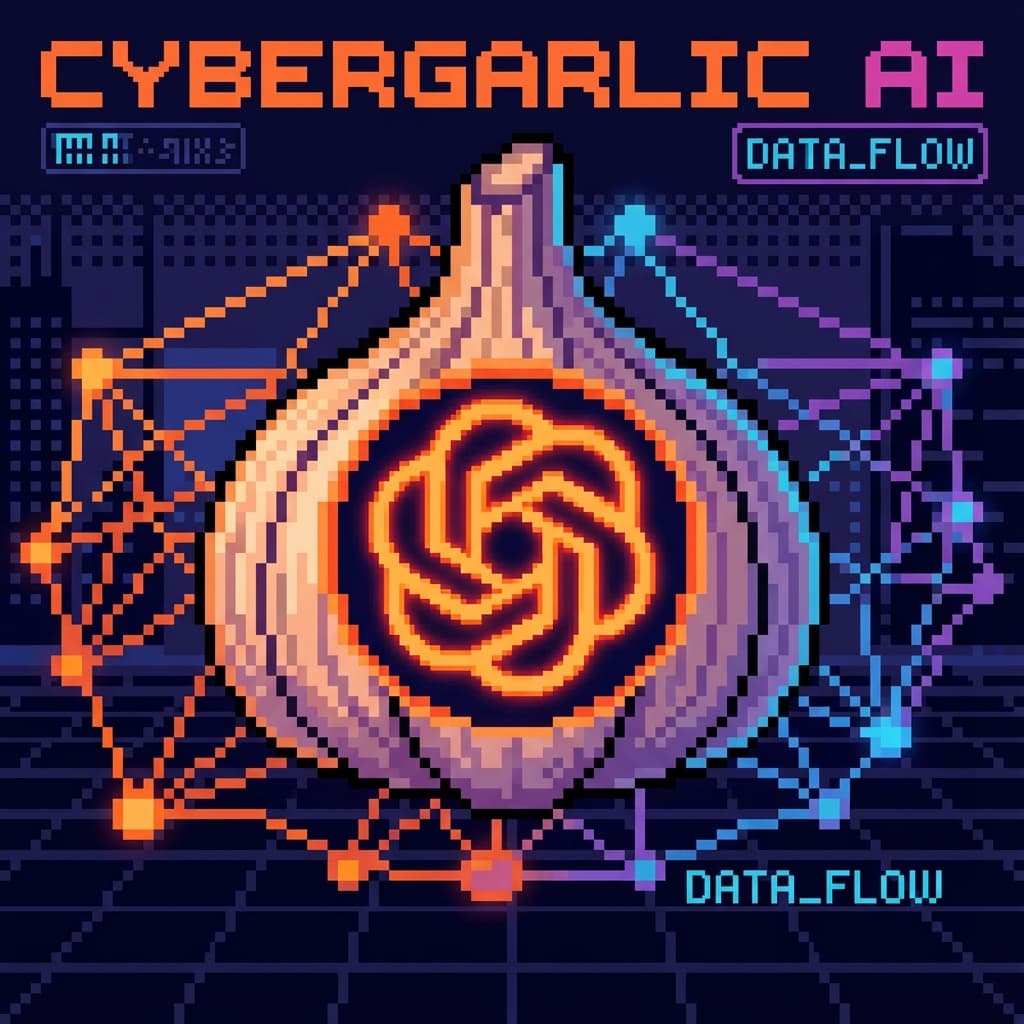
Okay, buckle up, buttercups! The Vibe Coder is ON, diving deep into the ergonomic wonderland of trackballs, the enigma of AI testing, and, of course, the juiciest AI gossip. Prepare for a Nano Banana flavored adventure!
Key Takeaways
- The Big Shift: How Agentic AI is changing the game.
- Actionable Insight: Immediate steps to secure your AI Privacy.
- Future Proof: Why Local LLMs are the ultimate privacy shield.
THE COVER STORY: OpenAI Announced GPT-5.2 (Garlic)
Hold the Nano Bananas! OpenAI just dropped GPT-5.2, codenamed "Garlic" during development, on December 11, 2025! Seems like Altman and crew heard the whispers about Google's Gemini 3 and decided to unleash some serious heat. This isn't just another version bump, folks; it's a statement. According to OpenAI, GPT-5.2 is the "most capable model series yet" for coding and agentic workflows. Forget those pesky polished files, though; Altman admits it can't do everything (Source: PCMag).
What's under the hood? We're talking a massive 400,000-token context window and a 128,000-token output capacity – reportedly 5x the context of GPT-4! This means you can throw entire codebases, lengthy API docs, and your grandma's secret recipe collection at it, all in one go. Apparently, "Garlic" was a parallel track of models and the company used fine-tuning and targeted improvements to make it better than Gemini 3.
Pricing is $1.75 per million input tokens and $14 per million output tokens, which is a 40% premium compared to GPT-5, but OpenAI argues that the expanded context window and improved reasoning are worth it (Source: The Neuron).
Word on the street (aka, the internet) is that Disney invested a cool $1 billion in OpenAI and is becoming the first major content partner for Sora. Mickey Mouse and Darth Vader in AI-generated shorts? The future is wild, y'all!
THE CREDENTIALS: AI Model Testing and AGI Certification - Are We Doomed?
Okay, let's talk about the grown-up stuff – AI model testing credentials and AGI certification. What do these even mean in our rapidly evolving AI landscape? Are they a safety net, or just another layer of complexity in a world we barely understand?
AI model evaluation certification is the formal process of assessing and validating AI models against predefined standards and benchmarks (Source: Meegle). These certifications aim to ensure that AI systems perform as intended, are free from biases, and adhere to ethical guidelines. The process involves rigorous testing of the model's accuracy, robustness, interpretability, and compliance with regulatory requirements.
Key components of AI Model Evaluation Certifications include:
- Fairness and Bias Detection
- Robustness and Reliability
- Explainability and Interpretability
- Compliance and Ethical Standards
- Security and Privacy
Several organizations offer AI testing certifications, such as the AI Testing Professional Certification (CAITP) by GSDC. NVIDIA also offers an Agentic AI LLMs professional certification (Source: NVIDIA).
But here's the Nano Banana question: Are these certifications enough to protect us from potential AI gone wild scenarios? Are we just "checking boxes" while AGI sneaks up and steals our jobs (or worse)?
The truth is, it's complicated. Certifications are a good start, providing a framework for responsible AI development. However, they are not a silver bullet. Continuous monitoring, ethical considerations, and ongoing research are crucial to ensure AI benefits humanity, not destroys it.
Join the Vibe Coder Resistance
Get the "Agentic AI Starter Kit" and weekly anti-hype patterns delivered to your inbox.
Join the Vibe Coder Resistance
Get the "Agentic AI Starter Kit" and weekly anti-hype patterns delivered to your inbox.
Join the Vibe Coder Resistance
Get the "Agentic AI Starter Kit" and weekly anti-hype patterns delivered to your inbox.
MIXTURE OF EXPERTS: The Secret Sauce?
Mixture of Experts (MoE) is an AI architecture that divides a model into multiple specialized sub-networks, or "experts," each trained to handle specific types of data or tasks within the model. These experts work under the guidance of a "gating network," which selects and activates the most relevant experts for each input.
We here at Vibe Coder are firm believers in the power of MoE. Why? Because it allows for more efficient use of computational resources. Instead of activating the entire neural network for every task, MoE selectively activates only the experts needed for a given task. This can greatly reduce computation costs during pre-training and achieve faster performance during inference time.
Think of it like this: instead of one giant brain trying to do everything, you have a team of specialists, each focusing on their area of expertise. It's faster, more efficient, and potentially more accurate.
MEMORY_INTEGRITY_CHECK
Match the data pairs before your context window collapses.
Fun History Section
Did you know that the concept of Mixture of Experts was first introduced in 1991? Robert Jacobs and Geoffrey Hinton proposed dividing tasks among smaller, specialized networks to reduce training times and computational requirements. Fast forward to today, and MoE is employed in some of the largest deep learning models, including Google's Switch Transformers and Mistral's Mixtral (Source: Metaschool, IBM, Forbes). See, AI history can be fun!
THE VERDICT: Strategic Advice
So, what's the takeaway from all this?
- Stay Informed: Keep up with the latest AI developments, including new models like GPT-5.2 and emerging architectures like MoE.
- Embrace Certifications (With Caution): AI model testing credentials are a valuable tool, but don't rely on them as the only safeguard.
- Demand Transparency: Push for greater transparency in AI development and deployment. Understand how AI models are being used and what impact they might have.
- Be Ethical: Always consider the ethical implications of AI. Ensure that AI systems are fair, unbiased, and aligned with human values.
The AI revolution is here, folks. It's time to buckle up, stay informed, and demand a responsible and ethical AI future. And maybe invest in a good trackball for those long hours of coding and AI wrangling. 😉
Build Your Own Agentic AI?
Don't get left behind in the 2025 AI revolution. Join 15,000+ developers getting weekly code patterns.